A Closed Account Is Not the Final Word: Nine Checks for UK Customers in 2026
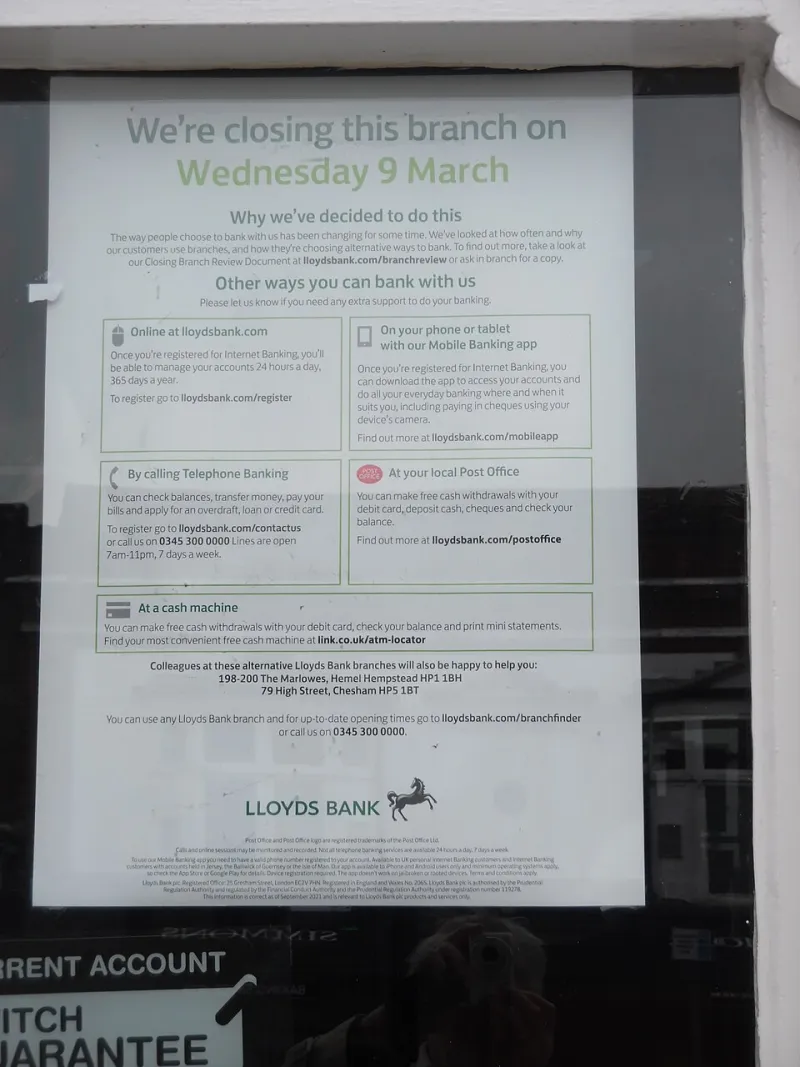
Photo: David Hillas , CC BY-SA 2.0, via Wikimedia Commons
An account closure letter is designed to sound final. In practice, it is a decision made inside a process: a contractual term is identified, a notice period is applied, a risk team records a rationale, and a complaints route opens. Before a customer treats the bank's position as the end of the matter, it helps to test that process. The nine questions below are not a template for avoiding a legitimate closure. They are a way to establish whether the bank has followed its own terms and the fair-treatment standards the FCA expects in 2026.
1. What is the bank actually ending?
Is it a full closure, a suspension, a restriction on payments, or the withdrawal of a particular facility? Ask for the wording in writing. The distinction matters: a suspension may be temporary and have a review date, while a closure is terminal. Request the exact product or products affected and the date on which the bank says the account will end.
2. Which contractual term and notice period are being used?
Most personal current account terms allow the bank to close an account with notice, and many cite two months. Check the contract and the date in the letter. Ask when notice starts, whether weekends or bank holidays count, and whether incoming payments will be accepted after the closure date. If the bank says it must close immediately for security reasons, ask for the contractual or legal basis and for any urgent exceptions.
3. What reason will the bank put in writing?
Banks may decline to give detailed reasons where financial crime prevention applies. They should still give as much as they can in writing and explain any refusal. Ask whether a fraud marker or internal risk flag has been recorded, and which team owns it. A vague letter is not a substitute for a decision record.
4. Has the bank considered vulnerability or access needs?
The FCA Consumer Duty and vulnerability guidance require firms to consider customers who may be in vulnerable circumstances. If illness, bereavement, disability, caring responsibilities, domestic abuse, language barriers or financial hardship affect the ability to switch accounts, say so in writing. Ask for reasonable adjustments, extra time and a named contact. This is not a tactic; it is relevant to fair treatment.
5. What is the complaint route and the eight-week clock?
Ask for the bank's complaints procedure and a complaint reference. Put the complaint in writing. The bank should give a final response within eight weeks; if it does not, the customer can go to the Financial Ombudsman Service. Keep copies of every letter and email. Ask what date the bank received the complaint, because that starts the clock.
6. What happens to payments and credit?
List direct debits, standing orders, salary, benefits, card subscriptions, overdraft, and any loan or mortgage linked to the account. Ask the bank for a payment diversion period and for statements. If benefits are paid into the account, contact the Department for Work and Pensions or the relevant authority. If a credit facility is affected, ask how closure affects repayment and the credit file. Do not assume the Current Account Switch Service will capture everything.
7. What data will be shared, and will a marker be filed?
Ask whether the bank will file a Cifas marker, close the account only, or share information with other providers. If a marker is involved, ask for its category and the correction route. Submit a subject access request for the bank's records. This is the point at which a closure complaint can become a data dispute.
8. What outcome are you requesting?
Be specific. You might ask for reinstatement, longer notice, a written explanation, correction of data, compensation for direct costs, or confirmation that no marker has been filed. A complaint without a requested outcome is harder to resolve. Ask the bank to confirm in writing what it will and will not do.
9. What is the escalation route and deadline?
If the final response is unsatisfactory, or eight weeks pass without one, the Financial Ombudsman Service is usually the next step. Complaints normally need to go to the ombudsman within six months of the final response. Ask it to consider whether the bank acted fairly and followed its terms. Keep evidence. If the issue is data accuracy, the Information Commissioner's Office may also be relevant. If access to money is urgent, seek specialist advice.
A printable call script
Before calling, have the account number, the closure letter, dates, a list of payments and any complaint reference in front of you. Use this script as a structure, not a word-for-word performance.
I am calling about the closure letter dated [date]. I want to make a formal complaint. Please confirm the contractual term and notice period the bank is relying on, and the date the account will close. Please also confirm in writing whether a fraud marker or internal risk flag has been recorded. I am asking for a written explanation, a payment diversion period and details of the complaints route. Please give me a call reference and send confirmation by email.
Write down the name of the person you speak to, the time, the call reference and what they promised. Follow up with an email that repeats your requests. If the bank calls you, ask for the same points in writing.
The bottom line
Accepting a bank's decision is sometimes the sensible course. But acceptance should follow evidence, not just a firm-sounding letter. A customer who asks these nine questions is not being difficult; they are testing whether the closure has been handled in line with the contract and the standards the FCA expects. If the answers do not add up, the complaint and ombudsman routes exist for that reason.